Welcome!
I’m here for you. Any comments or questions, please send me an email: ragnhild@wesenberg.org
Where to start:
Cello practice is exactly that, a practice. You can achieve it already today by placing the bow on the string and being present with your experience. To guide you in your practice, see if you find anything useful in my videos. But don’t forget that the point of all this is your personal, unique practice.
Shoot me an email and say hi, a little bit about yourself and what you want to gain from this course. That way, I can get an idea of what type of material I can make for you in order to help you reach your goals.
If you don’t get a reply from me within 3 days, maybe I didn’t receive your email. In that case, please contact me via my Instagram (send me a message, my Instagram handle is a_cello_way_of_life_). If you prefer WhatsApp, my number is +4672 916 3256.
Have a look around at the videos, writings and information sheets - see if you can find something that’s useful for you.
What’s brewing these days? I’m working on gathering my knowledge into a book - a PDF - in order to create more of a coherence in this course. I will then remove the separate sheets that are currently available here, and base my videos on the book as well. I’m aiming to finish the book by the summer.
—————————————————————
I’m so impressed by these beautiful images taken from inside the cello, by Charles Brooks: Lockey Hill Cello Circa 1780 – charlesbrooksphotography (architectureinmusic.com)
You have access to:
Video Tutorials.
At the moment of writing, there are 49 videos here available for you.
Writings.
- the vault of text-based information and inspiration! Check it out.
Sheets.
In the description of some of the videos there are links to related information that you can download.
I’ve looked around - what now?
You want to explore what your cello practice looks like.
Write it down in your planner, something like “wednesday 4-4:30pm cello practice”.
If you are completely new to cello playing, use that dedicated half hour to look at the Introduction Videos one by one as you unpack your cello and start to get acquainted with it. Then, after you’ve gotten the hang of setting the stage for yourself, move on to the Basic Technique and Practice videos. All in your own tempo.
-I’m feeling confused and don’t know where to begin.
Playing the cello is a combination of many aspects, so take one thing at a time:
1) If you don’t have a cello, you’ll want to find one. More about that, in episode 2 of the Cellist’s Journey, here.
2) When you have a cello, unpack it. Find a chair. Place the cello in front of you. More about this in the introductory videos.
3) When you can unpack, tighten the bow, place the cello in front of you and play the open strings, you’ll allow yourself to be guided by your interests; playing for playing’s sake, or working towards a defined goal. Some of my pupils want to simply play and enjoy the vibrations of the instrument, to use it as a kind of meditation and satisfying challenge, while others want to eventually play in an orchestra or together with their friends and thus having a guiding star to reach for. One of these approaches does not exclude the other! We can both work towards a goal and enjoy the process at the same time.
-My previous teacher said things differently from you.
Yes, cello playing is not at all standardized. Cellists, in the course of their studies, hear different things from numerous different teachers. This does not mean that some things are right while others are wrong. If you disagree with something I say, acknowledge that inner voice and respect it. Either choose to do it your way instead, or shoot me an email - I’d love to hear your comments.
-I don’t think I’m musical. I can’t even hear if I’m playing in tune.
It’s super common for beginner cellists to find intonation challenging. This does not at all mean that you are “not musical”. If you keep a regular practice going for a whole year to begin with, there will without a doubt be an improvement to your ability to play the cello. My pupils are for the most part adults who have full-time employment and kids and not much time to practice. Still, there is an inevitable progress that comes from the practice that does take place. Don’t give up before you have committed to your dream for at least one year!
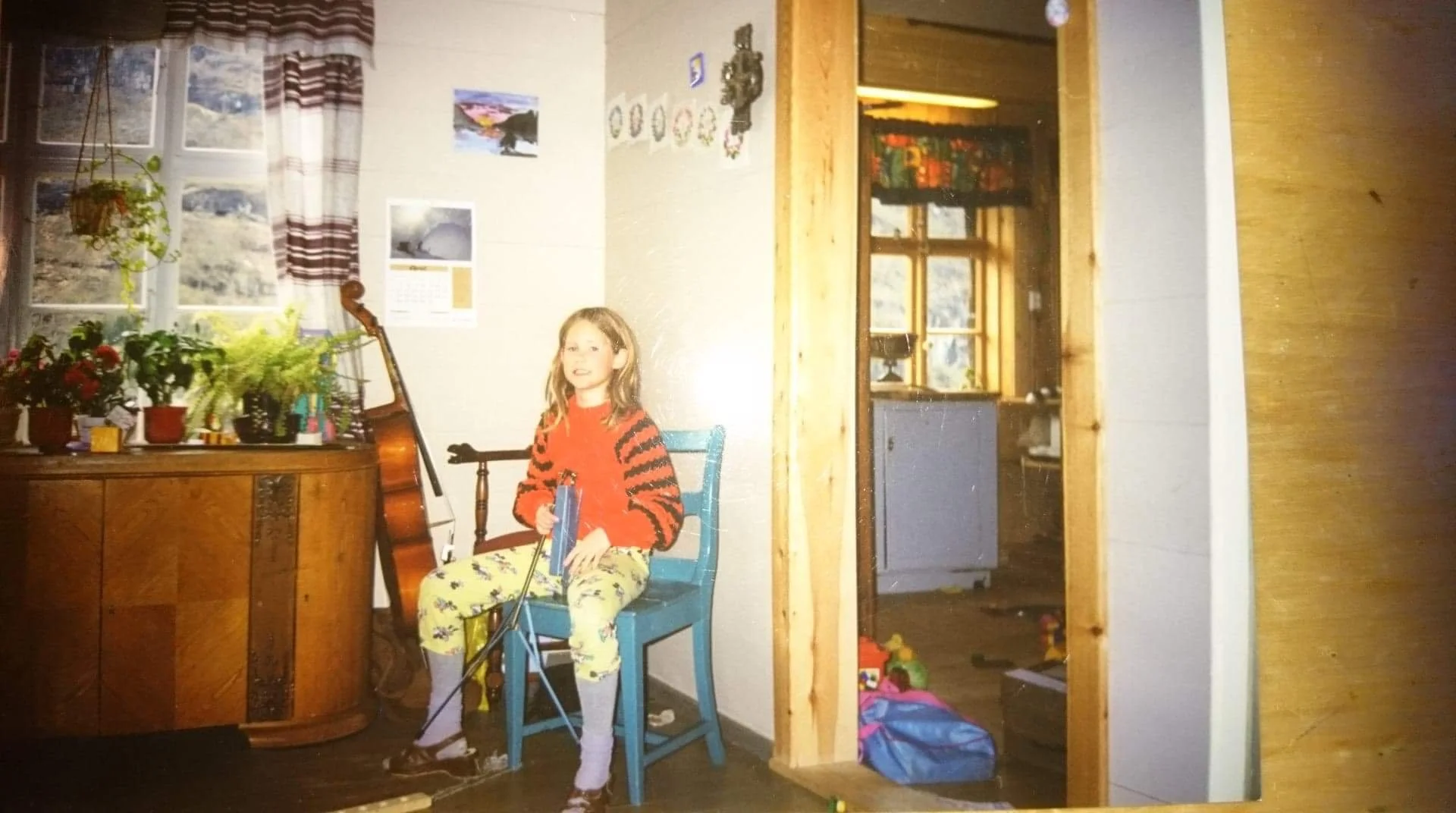
This is me, 9 years old, the year I started to play the cello. It was my mum’s suggestion, and I said ‘ok’ although I didn’t know what a cello was until I saw it on my first lesson. It wasn’t exactly love at first play, I wanted to quit during the first year. But my mother said I had to wait until the holidays before I could quit, and when the holidays came, I had forgotten that I had wanted to quit at some point earlier.
That first year, I was playing a very simple cello part that accompanied My Heart Will Go On; this was a year after Titanic came out as a movie. My mother had written D4, C1, A0 etc. over every note. I remember it was hard to read the notes without the helpful letters and numbers there. (The sooner you can play a note for the note that it is, rather than which letter is written above it, the better!) At the end of my first year, I performed in front of people for the first time, as a soloist. It was in the community building in the tiny village we lived in, by the longest fjord in the West of Norway. My mother was playing the piano, and I played the melody of Ave Maria, Bach/Gounod version. While I was playing, I was dreading the high E near the end of the piece; it was the only tone that was not in the 1st position, but in the 4th. I had practiced it at home but found it very difficult. I tensed up completely and hoped for the best as my hand moved down the neck in the search of this E… I remember that I played something at least very similar to an E, but the performance nerves covered most of the experience in a blanket of black-out as I’m thinking back at it.
Much later, I would be exploring this curious thing that happens during performance, this ‘stage fright’ or ‘performance anxiety’ that can come even when playing for the teacher in a lesson. And I was deeply fascinated by the psychology of cello practice. Playing the cello went through a journey from simply trying to get the notes right -a journey, by the way, that never ends!- to the joy of playing with other people, the thrill of learning a piece of music that was challenging to learn, and how cello playing took on a deeper meaning as my experiences of life unfolded.
For me, cello playing is a love for the actual practice. Yes, we sometimes want to perform music for other people, in a group or on one’s own, but this performance is usually not something of perfection, but rather, a snapshot from our life-long process of practicing the cello. As if we’re performing our yoga practice to someone. Everything we’ve ever done in our lives, with and without the cello, shapes this present moment of performing a piece to someone. It will sound different every time, and the listener listens in a different way every time as well. There are countless factors involved and the journey does not seem linear to me.
One of my favourite quotes is this:
“Music can express nothing. It is always our sentiment that ascribes to it qualities which correspond with certain traits in our mental disposition.” (Sextus Empiricus)
When we play an open C string, we give it meaning as we hear it. And if someone is listening, they will give it their meaning. It can be “this is boring, I need something to happen soon.” Or “the simplicity of playing on one string makes me aware of how much tension I’m carrying in my body right now.” Or “I feel this vibration in my body, shaking my cells back into place after a stressful day.” Or “this tone reminds me of this piece I used to listen to when I was younger.” Or “I can’t play as stable as I want to, my arm can’t relax.” Or “I’m feeling really angry about what this person said to me today.” Or perhaps there is no thought at all.
You are here to receive guidance on how to play the cello. In my experience so far with adult beginners, many tend to give themselves a hard time, high expectations that involves taking in a lot of information and practice. It quickly becomes unsustainable for many, everyday life becomes too stressful, and they give up on the cello to free up more space in their day.
I’m not going to say that there is a way of playing the cello that doesn’t take time away from something else in your day, but I would like to describe cello practice in a way that can take some pressure off if you are feeling stressed about it. Cello practice can be a sanctuary. When there are too many things to think about at the same time in your practice, slow down and focus on one of those things. If all you had the time for today was to hold the bow, that’s ok. Maybe the time was spent on tuning, that’s ok. Slow down, take one thing at the time, breathe, and don’t be scared of the sounds you’re making. Again, we can hear a ‘bad’ sound in different ways: “Ai, I better play as quietly as I can until I’m good at playing.” “That’s a fascinating sound, I’ve never heard anything like that before”. “Hm, I wonder if this happened because of the speed of my bow?” “Now, that sounded like modern music to me. I wonder if I can do it again?”
Is cello playing something to ‘achieve’, or is it something we just…do?