STRINGS: When to change them?
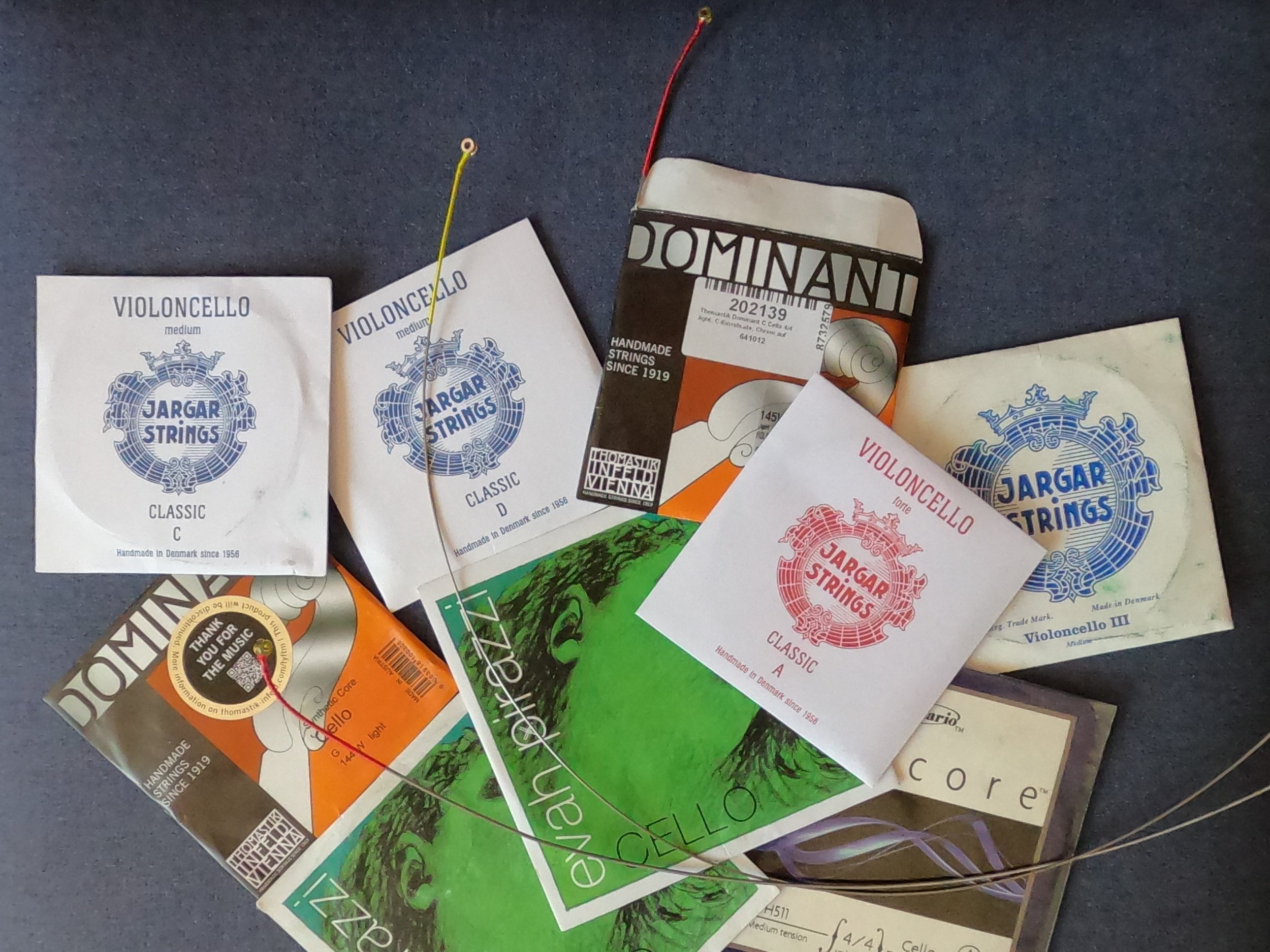
☝ Some of the strings that I found lying around at home at the time of writing.
What is there to know about cello strings?
-A lot!
How much is necessary for cellists to know about strings? That's what I'll be exploring here.
The minimum amount of strings knowledge required to play the cello is pretty much nothing.
You CAN simply tune and play, and change a string when it breaks. That's one end of the spectrum.
The other end of the spectrum is to go down the rabbit hole and try every possible type of string until you find the brand, or combination of brands, that you prefer for your cello.
-as well as to read and learn about strings in themselves, how they produce sound based on the string's length and material and thickness... You could get lost in this topic.
Most of us fall somewhere in the middle on this spectrum.
I'm one of those, happily hanging out somewhere in the middle.
Let's go back to the bare minimum, of only changing a string when it breaks.
We have good reasons to change our strings BEFORE they break:
the force of a string snapping can cause damage to the instrument (or to you)
playing on old strings can make us feel uninspired to play, and give us a sense of not getting any better
the added effort we put in to make our cello sound good, can make us tense and cause injuries to our body
We can avoid breaking the strings by regularly wiping off rosin and grease (from our skin) from the strings, as well as to always go slow on the tuning pegs. That being said, strings can break no matter how careful we are so don’t beat yourself up about it if it happens!
The first step out onto the strings spectrum for beginner cellists is usually that we don't like the sound of our strings.
Typically, the A-string is piercing, while the C-string is muffled.
This can be because
the quality of the strings wasn't great in the first place (which is often the case for cheap cellos)
the strings are not the best fit for your cello
or because the strings are worn-out.
Something you can do is to ask your teacher to play your cello so that you can listen to it; if it sounds great, maybe the sound has more to do with your technique than with the strings.
Your teacher can also give you their recommendation as to whether or not to change the strings. The problem could even be an insufficient amount of rosin on the bow hair.
Apart from judging how the strings sound, there are also other signs that we can look for.
if we see that a string is unravelling, we change it straight away
if the strings are harder to keep in tune than normally, this might be a sign of them being worn-out
if we've been playing our cello for more than a year, it's probably time to change the strings
Besides, the more times you change your strings, the more you learn how it feels to play with new strings and it becomes easier to get a sense for when you want to change them the next time.
IMPORTANT: your brand new strings may sound strange in the very beginning. Do not despair! It takes some days (or a couple of weeks, depending on how much you play) for the strings to sound as good as you expect them to.
Keep your old strings. If one of your new strings break, you can use your old string until you have gotten hold of a new new one.
Which strings to buy?
That's a good question.
I usually recommend Jargar for my students, because they sound great while being relatively inexpensive.
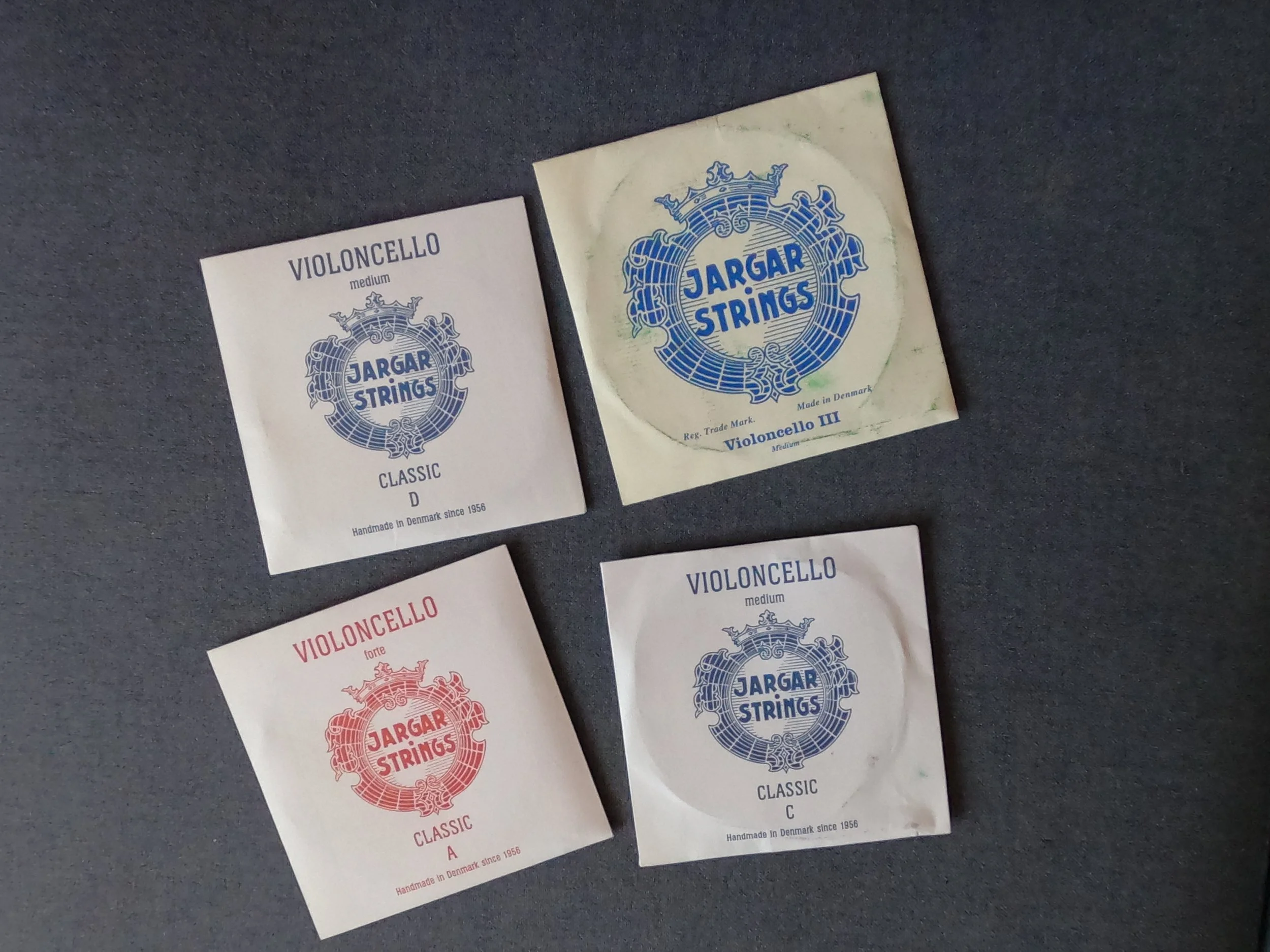
Another safe option is Larsen. There will be no disappointment with Larsen.
It's quite common to combine brands, e.g. to use Larsen for the upper strings and Jargar for the lower strings.
One of my old teachers preferred Larsen on the upper strings and Spirocore Wolfram on the lower strings.
When it comes to WHICH SET of strings to choose from a brand (Classic, Superior, Special, etc), read the descriptions, look at the price, and follow your gut feeling.
Take note of your experience, so that you can compare it to a different set from the same brand if you choose to experiment later.
…It's a bit like comparing different brands of chocolate consisting of 85% cacao. The ingredients are almost the same, but there are nevertheless subtle differences in flavour and texture between all of them.
The right answer is in your preference, and your budget. And sometimes you just want to try a different brand.
If you don't find my chocolate metaphor satisfying, I recommend that you browse the websites of the string manufacturers. They have a lot of information about their strings, how they work and how they are made.
The website of Thomastik-Infeld, the maker of the Spirocore strings, has a 'Stringfinder' which is worth checking out!
You can also dig into the topic of strings in general on Wikipedia.
I have not tried all the strings on the market.
I once bought a strings brand I'd never even heard of, to widen my horizon a little bit.
The new string broke before I'd even had the chance to play it! And so my adventure ended abruptly.
It's not fun to spend money on strings that won't even be played on.

(☝ This brand did not work for me.)
So I tend to stick to my favourite, which is Evah Pirazzi. They are expensive! So I use them until I clearly hear that they are worn-out. I change them roughly once a year. I love the clarity, especially on the lower strings.
An ♥Evah Pirazzi C-string♥ is heaven to me. Many prefer a 'warmer' sound, while I love the metallic force of these strings.
So, here at the end I'd like to issue a warning: if you start to discover the more expensive strings, it's hard to go back...

Source: Connolly Music
Do you need help with changing your strings? I have a video to guide you here.